COUNT IN THE GROUP
Originating in eastern Cuba's changüí and son cubano traditions around Guantánamo and Santiago de Cuba, bongos are the ultimate picnic instrument: compact, warm-toned, and expressive at low volume without drowning out conversation. Here is how to get a relaxed groove going on the blanket in five minutes.
TRY THE RHYTHM TILES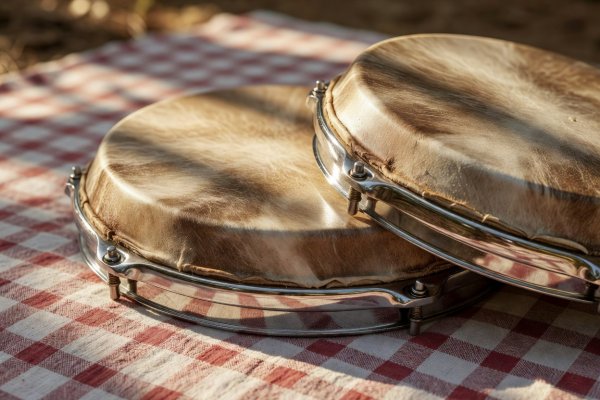
HOLD & STRIKE WITHOUT SORE HANDS
WARM RINGING EDGE
Strike the outer third of the drumhead with the pads of your index, middle, and ring fingers together, letting your fingers bounce off immediately so the natural skin sings freely. Position the larger drum (hembra, 7-inch) on your right if you are right-handed, and the smaller drum (macho, 6-inch) on your left.
DRY POCKET PULSE
Roll your left hand slightly inward so the side of your thumb presses gently into the centre of the smaller macho head, staying down on the skin to produce a short, woody pitch. This thumb stroke naturally sets up your fingertips for the very next beat.
SOFT GHOST NOTE
While your left thumb rests lightly on the head, drop your right index and middle fingertips near the rim for a soft, crisp tick. Because your hands stay relaxed and low, you can play for twenty minutes on a picnic blanket without any wrist fatigue.
THREE PICNIC-READY GROOVES
THE MARTILLO ("THE HAMMER") AT 76 BPM
Click any tile to customise the stroke. Say the vocal mnemonic out loud while your hands learn the rocking motion between thumb and fingers: "Thumb-Tip-Thumb-Open, Thumb-Tip-Low-Open."
3-2 SON CLAVE TIMELINE
Have two friends clap this two-bar timeline lightly with cupped hands while you play the Martillo on the bongos. The active beats fall on 1, the & of 2, and 4 in the first bar, followed by 2 and 3 in the answer bar.
CALYPSO MEADOW SYNCOPATION
Ideal for golden hour when the picnic slows down. Leave gentle breathing spaces (-) between the open tones on the high and low drums.
PARK ETIQUETTE & RAWHIDE CARE
THE 20-METRE ACOUSTIC RULE
Hand drums carry differently across open grass than indoors. Follow three simple rules so park rangers and neighbouring blankets always welcome your group:
1. Check the 20-Metre Radius: Set up at least 20 metres from other seated groups, quiet reading benches, or waterfowl ponds.
2. Seated Cross-Legged Muffling: If you are in a busier urban square, rest the bottom rim of the bongos lightly against your shins rather than holding them high between your knees; this trims low-frequency projection by 40% while keeping the crisp top-end articulation clear for your circle.
3. Keep Sessions to 15-Minute Bursts: Play for fifteen minutes, then set the drums down and pass the bowl of olives.
PROTECTING NATURAL HEADS OUTDOORS
Traditional buffalo or steer rawhide drumheads found on quality Siam oak or ash shells react quickly to outdoor temperature and humidity shifts:
• Shade Only: Direct afternoon sunlight rapidly dries and tightens rawhide, raising pitch sharply and stressing the crown hoop. Always tuck your bongos into tree shade when you stand up for a lawn game.
• Detune Before Packing: Before zipping the drums into their bag at the end of the afternoon, use your 13mm tuning wrench to loosen each of the four lugs on the macho drum by half a turn so evening cooling never splits the skin.
• Wipe Hands First: Sunscreen and olive oil deaden natural drumheads. Keep your damp microfibre cloth handy before counting in the group.